Minute Man Fossils
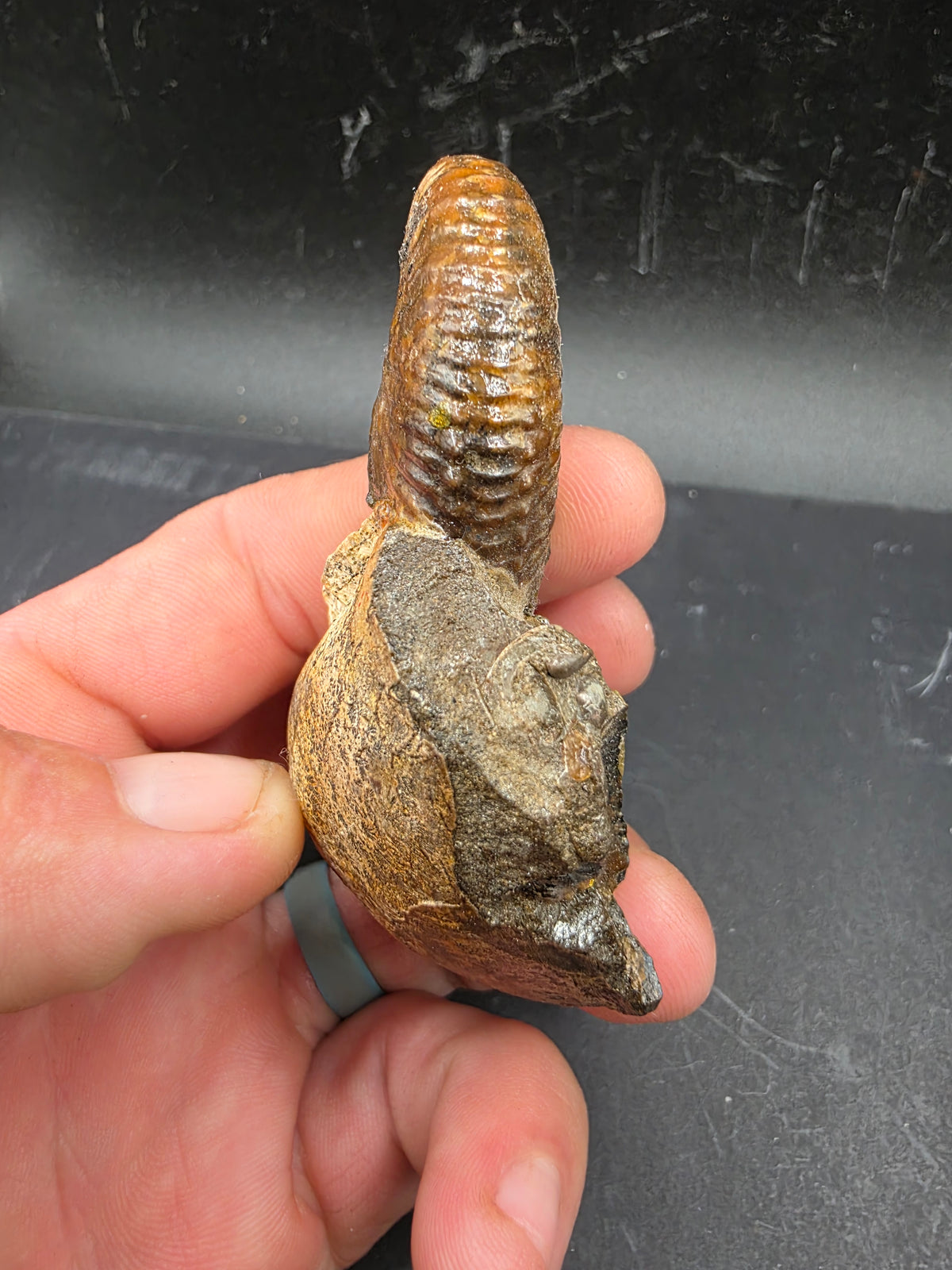
Discoscaphites sp.-South Dakota
Discoscaphites sp.-South Dakota
Couldn't load pickup availability
Taxa: Discoscaphites sp.; Inoceramid
Geology: Fox Hills formation
Age: Cretaceous
Locality: Pennington County, South Dakota
This specimen has 2 Discoscaphites and an Inoceramid. The free standing ammonite appears to has been reattached.
Discoscaphites
Discoscaphites was an extinct genus of scaphitid ammonites, marine cephalopods that lived in shallow epicontinental seas during the latest Maastrichtian stage of the Late Cretaceous, just before the K-Pg mass extinction. These heteromorph ammonites had a distinctive shell morphology featuring an initial planispiral phragmocone followed by a partially uncoiled body chamber, often forming a J- or hook-shaped outline, with dimorphic forms—larger macroconchs (likely females) and smaller microconchs (likely males)—distinguished by size, robustness, and degree of uncoiling. Common species like D. iris and D. conradi are index fossils for uppermost Maastrichtian biostratigraphy across the U.S. Gulf and Atlantic Coastal Plains (e.g., Owl Creek, Fox Hills, and Tinton Formations), where they occur abundantly in fossiliferous concretions and shales, sometimes alongside gastropods or near the iridium anomaly; their sutures are complexly incised, and some specimens preserve nacreous aragonite shells. Discoscaphites may represent one of the few ammonite groups with debated post-extinction survival into the lowermost Danian at select sites like New Jersey's Pinna Layer, highlighting their role in end-Cretaceous marine ecology and rapid extinction dynamics.
Fox Hills formation
The Fox Hills Formation is a Late Cretaceous (Maastrichtian) marginal-marine to shallow-marine geologic unit spanning the northwestern Great Plains from Alberta to Colorado, consisting primarily of yellow to gray, fine- to medium-grained sandstones interbedded with shales, silts, and clays that record the regressive retreat of the Western Interior Seaway. It typically forms an upward-coarsening sequence 30–100+ meters thick divided into members like the basal Trail City (massive, hummocky cross-stratified sands from storm deposits), Timber Lake (hummocky-bedded sands), and upper Colgate or Linton (cross-bedded shoreface sands), reflecting barrier islands, shorefaces, lagoons, and tidal flats on a broad, storm-dominated shelf less than 40 m deep. Underlain by the Pierre or Lewis Shale and overlain by continental Hell Creek or Lance deposits, it preserves abundant trace fossils (e.g., burrows), bivalves, ammonites like Baculites, gastropods, and rare vertebrate remains such as mosasaurs and dinosaurs, with heavy minerals like green amphibole indicating sediment sources from the rising Rockies.